


During the Son Doong expedition, the Passchendaele Passage is a 400-meter-long muddy challenge that leaves a lasting impression on many explorers. However, this passage undergoes a magical seasonal transformation – dry periods bring thick, sticky mud, while the rainy season turns it into a mystical, turquoise underground lake. This unique, majestic beauty was once featured in National Geographic’s “Your Shot” and has become a source of inspiration for numerous international photographers.
This article will explain the unique origin of the name Passchendaele, while detailing the starkly different real-life experiences between the rainy and dry seasons to help you best prepare for your journey.
Overview of the “Son Doong Passchendaele Passage”
To understand why the Son Doong Cave expedition is ranked among the world’s most dangerous adventures, you must directly face the unique topographical structures deep inside the cave. The Passchendaele Passage is a subterranean corridor spanning approximately 400 meters, located deep within the Son Doong Cave system of Phong Nha – Ke Bang National Park.
In terms of the route, explorers will officially set foot in this passage on the 5th day of the expedition, immediately after leaving Doline 2 (also known as the Garden of Edam) and heading toward The Great Wall of Vietnam. Crossing this passage is mandatory because the mechanical structure of Son Doong Cave is a straight line connecting the entrance to the exit. The Passchendaele Passage acts as the sole corridor linking the main cave passage to the base of the Great Wall of Vietnam. To reach the foot of this massive 90-meter-high calcite wall and climb the ropes to exit through the cave’s back door – completing the full expedition instead of turning back the same way – every explorer has no choice but to face and overcome the challenging 400 meters of Passchendaele.
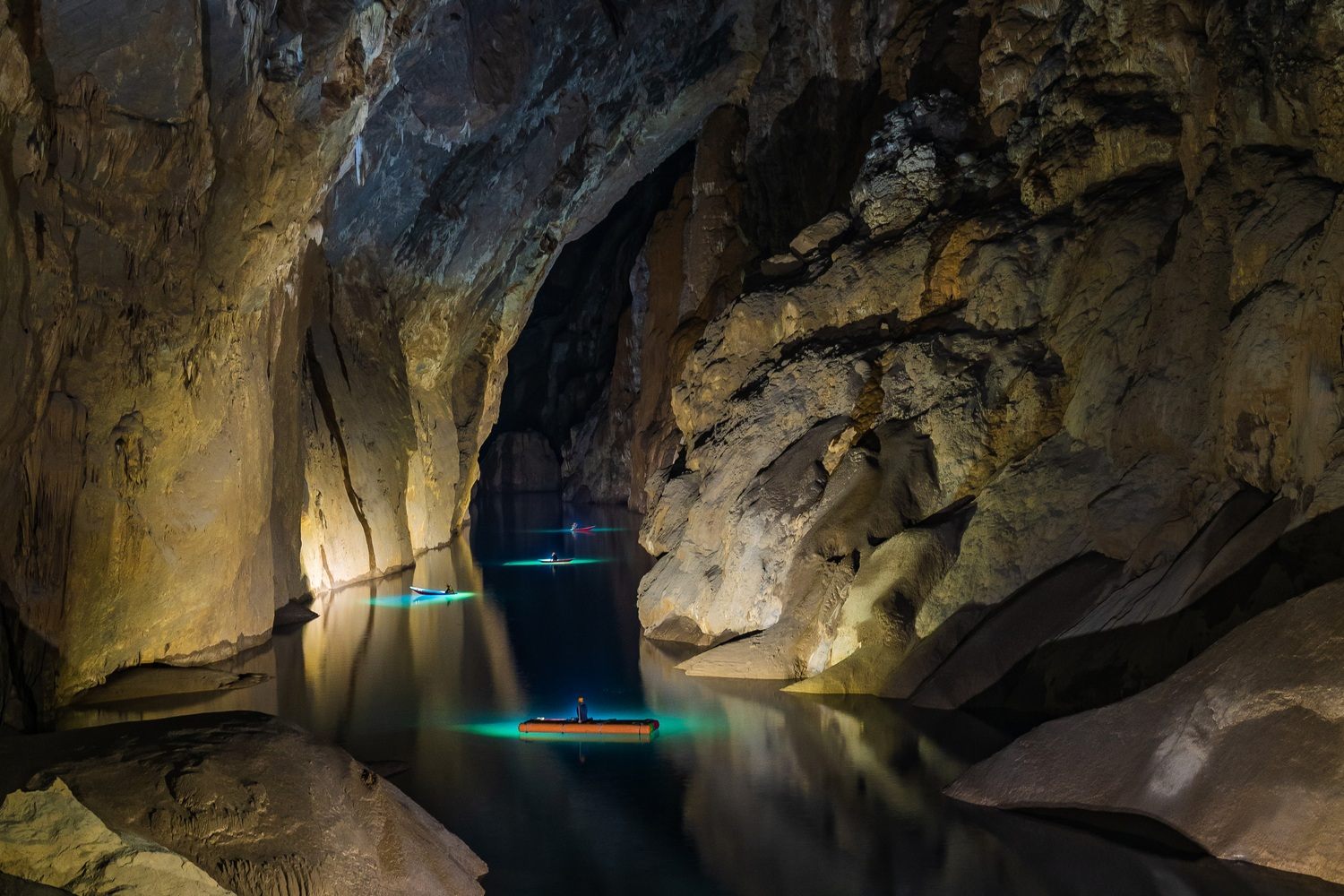
Geologically, this passage is part of the primary drainage system of the ancient limestone block that forms Son Doong. This corridor was shaped over millions of years by the flow of an active underground river. As the rushing water swept away loose sediments and eroded the limestone through rainwater acidity, it left behind a narrow, sloped tunnel that accumulates a massive amount of deposited mud after each flood season. The settling of this fine mud layer is the exact “specialty” that creates both an obsession and a badge of pride for anyone who passes through.
The Origin of the Name: An Epic from World War I
The name “Passchendaele” is not a native Vietnamese term, nor was it chosen at random. It was named after one of the most brutal battles in World War I history—the Battle of Passchendaele, which took place in Belgium in 1917 (also known as the Third Battle of Ypres). In military history, this battle is synonymous with relentless, pouring rain and a landscape churned into a vast sea of thick mud that trapped the soldiers’ feet, demanding extraordinary willpower and physical endurance to move or survive.
Why Cave Experts Named it “Passchendaele”
When the expedition team from the British Cave Research Association (BCRA) along with Vietnamese experts first approached and surveyed deep into this passage during the dry season, they faced a grueling reality. The 400-meter path ahead of them was not solid rock but a blanket of thick, gelatinous, and extremely slippery mud. With every step, the explorers found their feet tightly vacuum-sucked by the mud, which seemed determined to swallow their specialized trekking boots.
The dark, damp atmosphere and the intense physical toll of lifting each foot in the pitch-black cave immediately brought to mind the hardship and perseverance of the soldiers in the historic battle. It was from this powerful historical analogy that the name Son Doong’s Passchendaele Passage was born, serving as a tribute to human courage in the face of fierce nature.
Experiencing the Passchendaele Passage in Son Doong During the Dry Season
If you join the expedition during the dry season months, the Passchendaele Passage will welcome you with a highly challenging environment. At this time, the receding water leaves behind a ground covered in thick, dreggy mud that is as slippery as grease. This is no ordinary field mud; Son Doong’s subterranean mud is finely packed and creates a powerful vacuum suction. When you step down, your body weight pushes your foot deep into the mire, and when you attempt to lift it, the mud tightly grips your ankles.
The passage corridor is quite narrow, and natural light never reaches it, leaving you in complete, pitch-black silence broken only by the beams of your safety helmet lights. The sloped terrain and the invisible, uneven surfaces beneath the mud layer force explorers to constantly maintain their balance. A single moment of distraction can cause you to slip and end up entirely covered in mud.
Throughout the strenuous journey across Passchendaele, a team of professionally trained porters and safety assistants is always right by your side. These fit individuals know every corner and every deep mud pit within the passage. The safety assistants will guide you on the most accurate spots to place your feet, ready to pull you up the moment you sink or lose balance. Their constant presence and cheerful encouragement ensure your absolute physical safety and provide a solid mental anchor, helping you recharge your resolve to push through this challenging stretch.
A Spectacular Photo Opportunity: The Turquoise Underground Lake
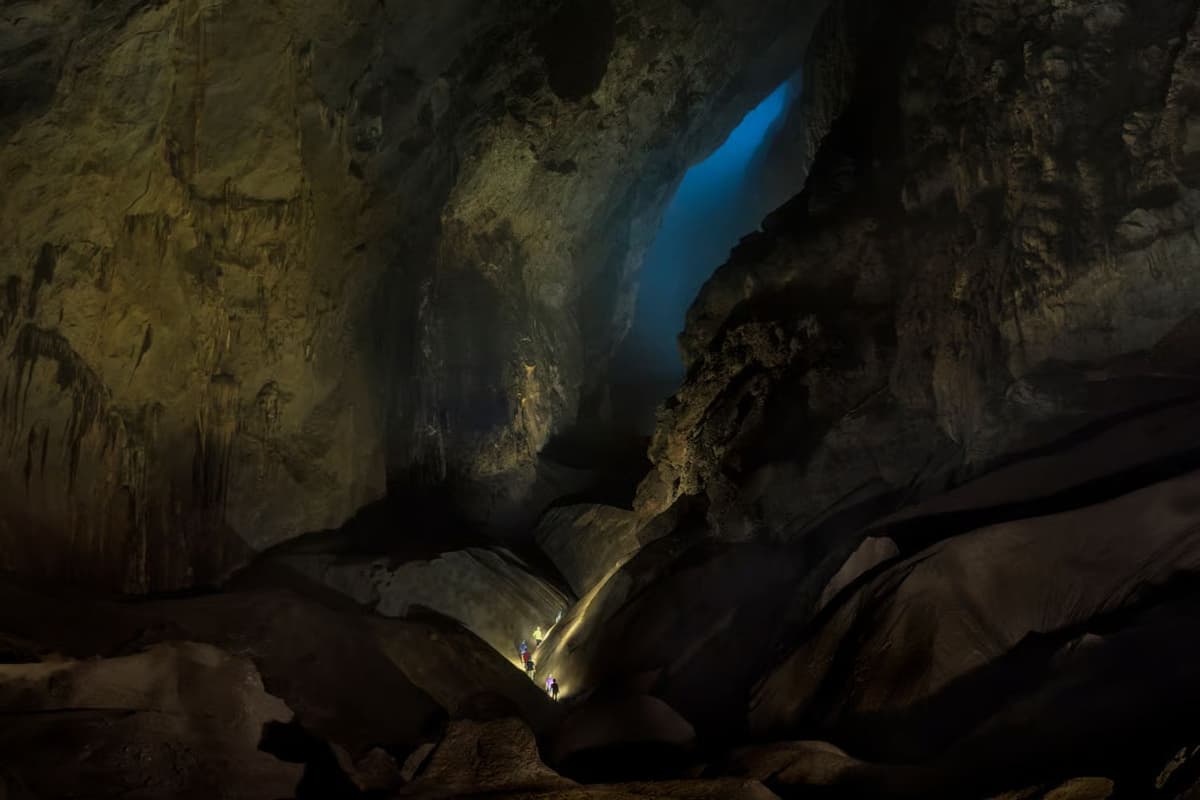
The magic of Son Doong Cave lies in the fact that it is a living entity, constantly changing with the seasons. When the rainy season arrives, massive volumes of water rush in from upstream rivers, completely flooding the Passchendaele Passage under an underground river system. The muddy floor of the dry season transitions into a vast, deep, and perfectly still subterranean lake.
This structural makeover is so spectacular that if a person visits Son Doong during both seasons, they would feel as though they are standing in two completely different worlds. The harsh, messy mud retreats to make way for a serene, ethereal beauty. Instead of exerting immense muscle power to trudge through thick mud, explorers visiting Son Doong during the high-water season experience a completely different journey, navigating the waters on specialized inflatable rafts.
Sitting on small inflatable rafts and drifting along the slow-moving currents of the underground lake, you will breathe in a crisp, primal air. The space becomes completely quiet, where only the gentle stroke of paddles and the distinct “plop” of water droplets falling from the hundred-meter-high ceiling onto the lake’s surface can be heard. What makes the flooded Passchendaele Passage a magnet for international photographers (evidenced by the stunning shots featured on National Geographic’s Your Shot) is the coloration of the water. The water here is purely transparent, glowing with a deep turquoise hue created by dissolved limestone minerals.
When you turn on your headlamps or when the expedition team’s high-power lighting systems sweep across the passage, the light reflecting off the water surface casts shimmering, crystal-like wave patterns onto the cave ceiling. Looking down into that turquoise water, you can admire massive stalactite fragments and million-year-old rock formations submerged deep within the lake. They appear hazy yet majestic, resembling a forgotten ancient city at the bottom of the ocean, creating a mystical, peerless landscape.
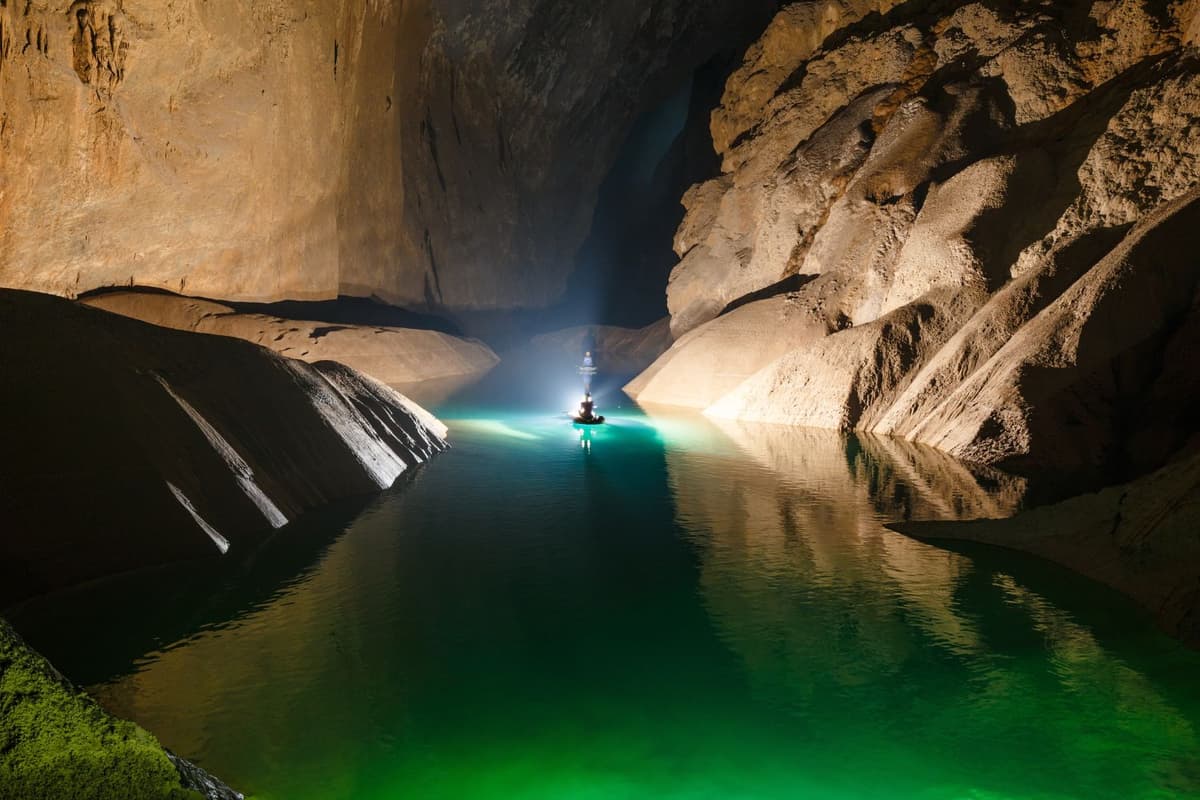
Even though the turquoise underground lake appears incredibly inviting and refreshing, sparking a desire among explorers to dive in, there is a strict rule: swimming is absolutely prohibited within the Passchendaele Passage. This measure is strictly enforced to ensure maximum safety during a tight expedition schedule, as this specific stretch lacks safe, rocky rest areas. Additionally, the underground lake water is extremely cold; diving in can trigger sudden muscle cramps or hypothermia. Therefore, explorers are only permitted to remain on the inflatable rafts to admire the view, ensuring absolute safety.
The Passchendaele Passage stands as a prime testament to the level of challenge presented by the Son Doong Cave expedition. Each season offers a completely distinct face, the grit and mental fortitude demanded by the dry season’s mud, and the enchanting, surreal charm of the flooded lake during the rainy months. We wish you excellent physical preparation as you embark on fulfilling your dream of conquering the largest cave on Earth!