




When exploring Son Doong Cave, beyond its breathtaking highlights such as massive dolines, towering stalagmites, underground rivers, and pristine jungle, visitors may also encounter rare geological formations known to explorers as cave pearls. These are among the cave’s most fascinating features. With their smooth, rounded, or flattened shapes, cave pearls create a mesmerizing sight that captures the attention of anyone who loves nature.
But what are cave pearls? Why do they form in Son Doong and other caves? And do they have any special scientific or aesthetic value? Let’s find out.
What are cave pearls?
Cave pearls are a type of speleothem that typically take the shape of spheres, flattened spheres, or occasionally resemble eggs. They form when water drips or flows continuously over limestone surfaces, gradually depositing calcium carbonate around a tiny grain of sand or other fragment. Over thousands of years, successive layers of calcite build up concentrically, creating a pearl-like structure.
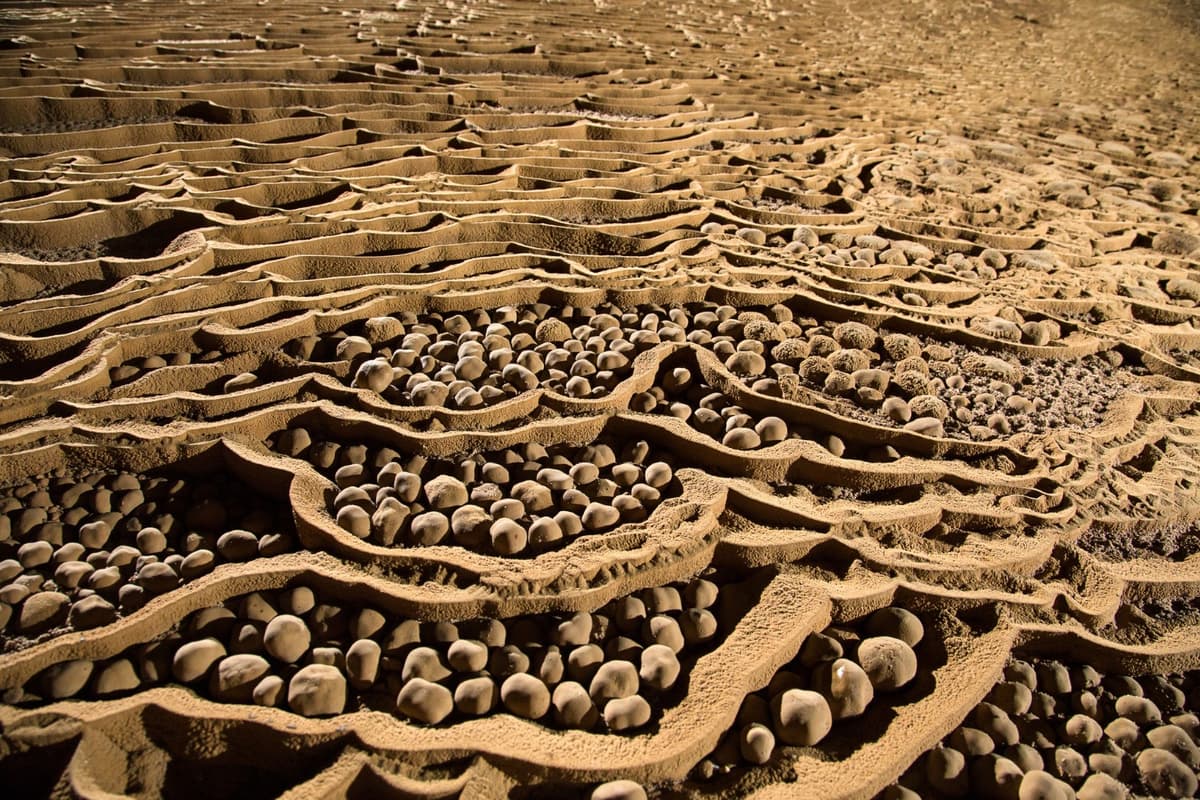
Some cave pearls develop rare shapes such as ellipses, hexagons, cylinders, or irregular blocks, adding variety and uniqueness to each cave. They are often found in rimstone pools—terraced basins along cave floors or walls that trap water long enough for minerals to settle. Sizes vary greatly, from as small as a pea to as large as a baseball.
Cave pearls are composed mainly of calcite, a common mineral in limestone. The nucleus at their center is often a grain of sand, though it can also be a bone fragment, piece of wood, resin, limestone chip, or clay that has been calcified. This nucleus serves as the starting point for the concentric crystal layers we see today.
How do cave pearls form?
They typically develop in gently sloping areas of a cave floor, especially within rimstone pools where water flow is slow and steady. Here, calcium-rich water – often carrying dissolved bicarbonate – drips from the cave ceiling. As it emerges from cracks in the limestone, the cave’s warmer temperature causes the water to lose carbon dioxide, reducing acidity and triggering calcite precipitation around the nucleus.
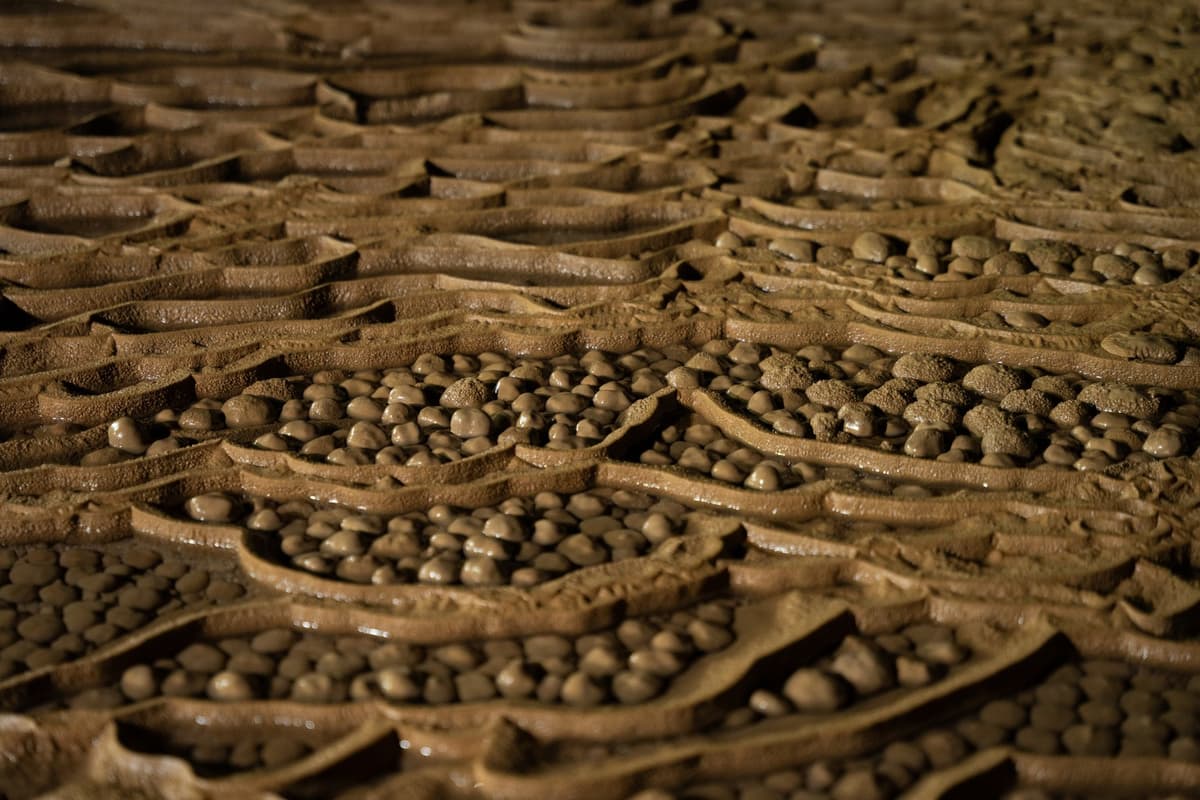
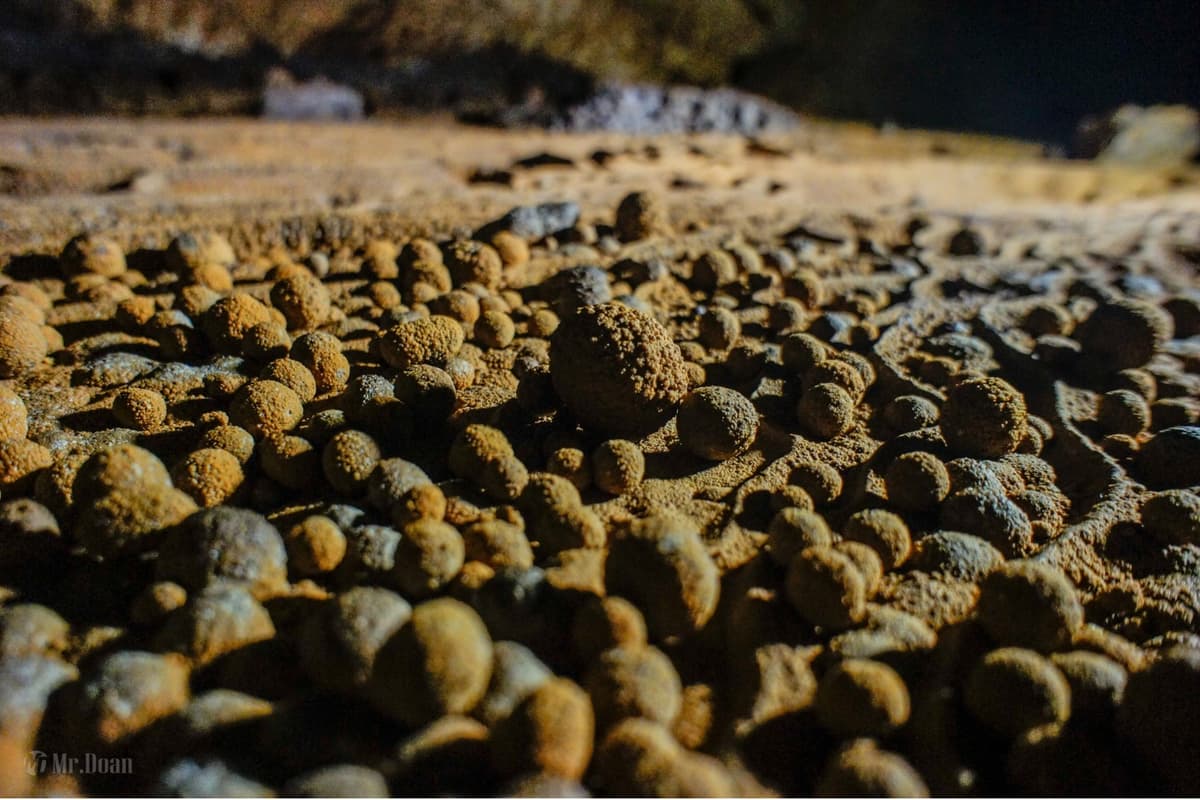
Because water flows continuously over the nucleus, mineral layers are deposited evenly from all sides rather than just one. Gentle water movement causes the nucleus to roll or rotate in place, producing a perfectly rounded or near-spherical form. In some cases, multiple nuclei may stick together during this process, creating a bumpy surface that resembles a custard apple.
Unlike stalagmites, which form from slow, steady drips, cave pearls require a more dynamic water environment. The faster, less stable flow prevents tall formations from developing and instead produces small, rounded deposits that rest on the cave floor or in shallow pools.
The process is not always continuous – seasonal changes can interrupt it. During dry periods, limited water supply slows growth, while during heavy rains, strong flows may wash away nuclei. Each cave pearl thus represents many cycles of growth, rotation, pause, and resumption over thousands of years.
Do cave pearls have any value?
No, cave pearls are not gemstones and have no commercial value. But they are scientifically and aesthetically significant. Their smooth, lustrous surfaces and natural symmetry make them a striking feature in limestone caves.
However, they are extremely fragile and maintain their beauty only when left undisturbed in their natural environment. Outside the cave, they can crack, fade, or deteriorate quickly due to changes in temperature, humidity, and handling.
To protect the geological heritage of this UNESCO World Natural Heritage site, Oxalis – the only company licensed to operate expeditions to Son Doong and the Tu Lan Cave System – strictly prohibits touching, moving, or damaging any cave formations, including cave pearls. Visitors are encouraged to observe and photograph them, but must never touch or remove them. Each pearl is not just a natural ornament but also a record of thousands of years of geological history, to be preserved for future generations.
Where can you see cave pearls?
1. Son Doong Cave, Quang Tri, Vietnam
In the world’s largest cave, cave pearls appear in an extraordinary variety of shapes and sizes, reflecting the differing environmental conditions in each section. Near the Passchendaele Corridor, they tend to form during the rainy season when acidic, carbonate-rich water flows strongly, depositing minerals around sand grains. For much of the rest of the year, the area remains dry, so the pearls here often have rough, textured surfaces.
By contrast, near the cave’s back entrance, where water flows year-round, pearls are smoother and noticeably larger. On a Son Doong Expedition, you might see pearls the size of baseballs, speckled like quail eggs. Cave expert Howard Limbert, who has explored caves around the world, has remarked that he has never seen cave pearls as numerous or as large as those in Son Doong.
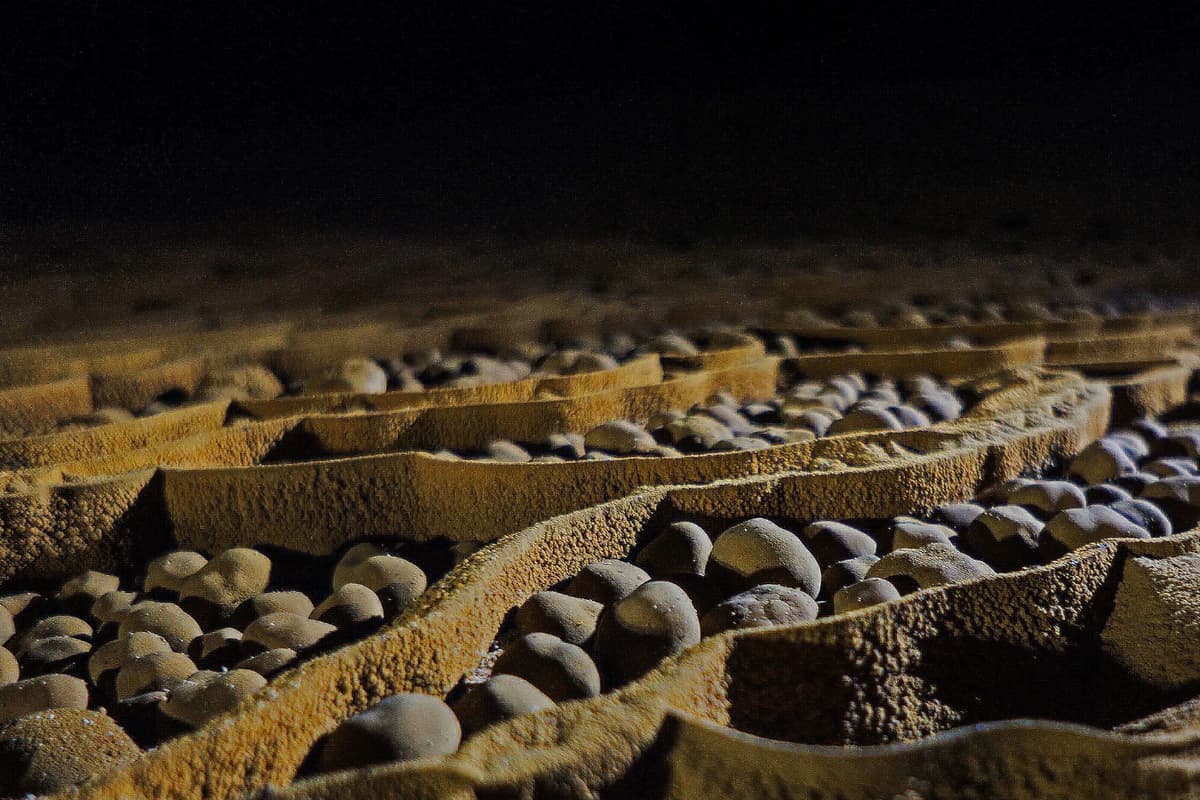
They are often found in rimstone terraces that dry out in the dry season, leaving hollows filled with what looks like trays of stone eggs. In other areas, tiny, newly formed pearls can be found, still soft and not yet fully crystallized.
2. Tu Lan Cave System (Tan Hoa, Quang Tri, Vietnam)
Outside of the famous Phong Nha–Ke Bang area, the Tu Lan Cave System is also home to remarkable formations, including rare cave pearls. Song Oxalis Cave features rimstone pools filled with pearls, while small clusters of tiny pearls create otherworldly scenes. In Tien 2 Cave, some pearls take on a custard-apple shape.

Hung Ton Cave contains trapezoid-shaped pearls, formed when part of the nucleus becomes fixed in place, allowing it to rotate only vertically. Visitors can explore the cavthein Tu Lan on a range of tours lasting from one to six days, such as:
- Tu Lan Cave Expedition (TL4)
- Hang Tien Cave Exploration (HT3)
- Wild Tu Lan Cave Explorer (TL3)
- Hang Tien Cave Endeavor (HT2)
- Hang Tien-Tu Lan Discovery (HTL)
- Tu Lan Cave Encounter (TL2)
- Hang Tien Cave Discovery (HT1)
- Tu Lan Cave Experience (TL1)
- Tu Lan Family Adventure (TF2)
- Tu Lan Family Experience (TF1)
3. Gruta de las Canicas (Marbles Cave), Tabasco, Mexico
Also known as Marbles Cave, this site in Tabasco, Mexico, holds one of the world’s largest concentrations of cave pearls. The cave is about 529 meters long and over 16 meters deep. Researchers estimate it contains around 200 million pearls, most located about 100 meters from the entrance. These pearls cover the cave floor to a depth of nearly one meter across more than 290 square meters, creating an astonishing natural spectacle.
4. Carlsbad Caverns, New Mexico, USA
In the United States, Carlsbad Caverns in New Mexico also hosts a famous collection of cave pearls, particularly in an area called the Rookery. Here, thousands of pearls cluster together in a wide, lower chamber of the cave. In the past, some were even handed out to visitors as souvenirs, but this practice has since been banned to preserve the cave’s delicate ecosystem.