


Without the rushing sound of the underground river, Son Doong Cave might have remained forever in darkness. It was that echoing sound from the depths that stayed in Mr. Ho Khanh’s memory for nearly 10 years, eventually guiding explorers to the entrance of Son Doong.
The underground river in Son Doong Cave is like a lifeline. It played a vital role in shaping one of the most magnificent caves on Earth while nurturing life and creating Son Doong’s unique climate and ecosystem. Sixteen years after its discovery, cave exploration experts have conducted numerous surveys. However, the underground river remains a mystery that continues to challenge the spirit of adventure.
Son Doong Cave – A symbol of Vietnam’s natural wonders
Son Doong Cave is located in the core zone of Phong Nha – Ke Bang National Park, in Quang Tri Province (formerly part of Quang Binh). To reach this destination, travelers must trek about 13 kilometers deep into the jungle and spend a night camping inside Hang En (Swallow Cave). They continued through Hang En to arrive at a small yet deep entrance hidden within the cliffs.
The journey to discover and explore Son Doong Cave was anything but easy. In 1990, while seeking shelter from the rain during a forest trip, Ho Khanh accidentally came across a small cave entrance. From within, clouds and a cool draft flowed out, accompanied by the roar of rushing water echoing from underground. This strange phenomenon made him somewhat cautious, yet deeply impressed, as his many years of jungle experience told him this could be the entrance to an enormous cave.
In 2008, when cave exploration experts asked residents about a cave near Hang En, Mr. Ho Khanh remembered the unusual entrance he had once found. However, after nearly a decade had passed, he couldn’t remember the exact location. It took him almost a full year of searching before he was able to rediscover the path leading to the entrance of Hang Son Doong Cave.
In 2009, the British-Vietnamese cave exploration team surveyed and mapped Son Doong Cave. They announce it as the largest natural cave in the world, home to massive stalagmites and a truly unique ecosystem. Over the past decade, experts have conducted three major expeditions. They revealed numerous discoveries about Son Doong’s structure and geology, and successfully scaled the 90-meter-high “Great Wall of Vietnam.”
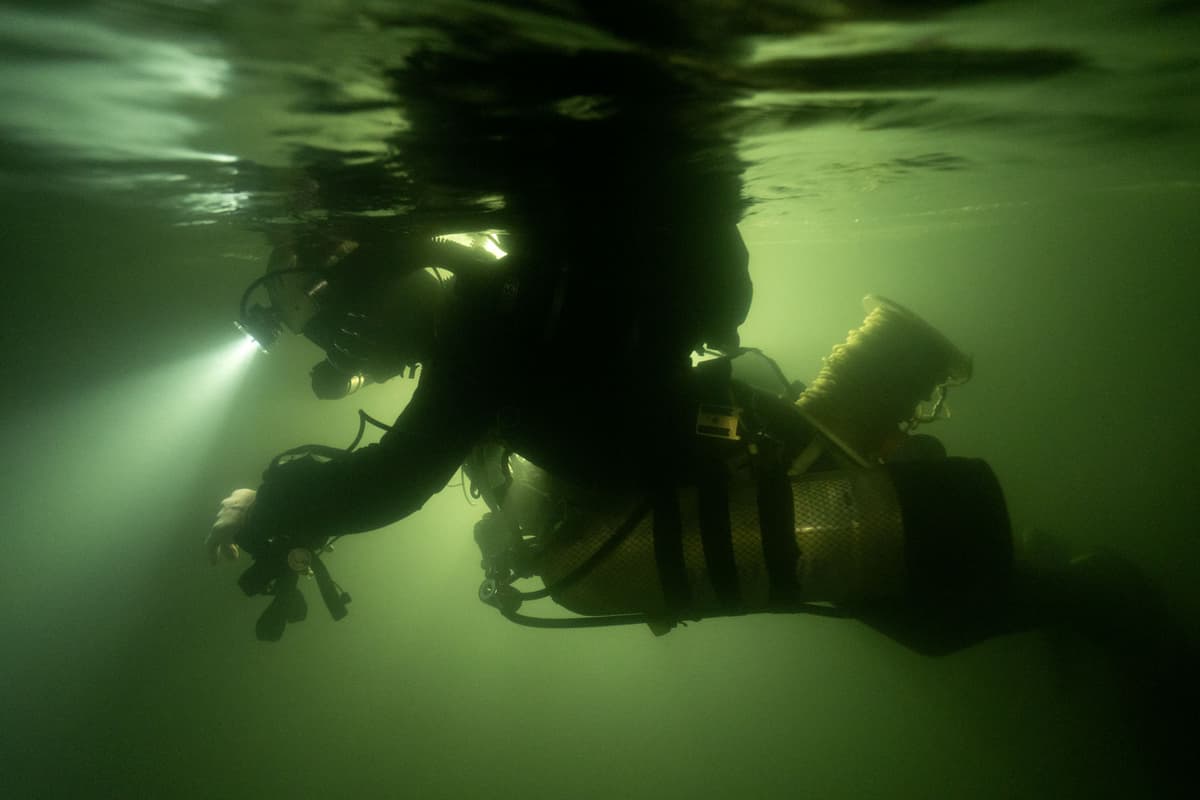
In 2019, experts launched a diving expedition to explore Son Doong’s underground river. The week-long survey led to the discovery of a passageway and a submerged cave at a depth of -60 meters. This finding presented a new challenge, inspiring explorers to plan future expeditions in the hope of unlocking the remaining mysteries of Son Doong.
The origin and role of the underground river in Hang Son Doong
Since the 1990s, explorers have discovered Hang En and Hang Khe Ry. They realized that both caves contain underground rivers with a large flow, converging into the same pristine valley before vanishing beneath the ground. They predicted that somewhere in this valley there must be an enormous cave, but despite years of searching, no new discovery was made.
It wasn’t until 2008, when they met Mr. Ho Khanh, that the explorers gained a vital clue, which led to the first survey of Son Doong Cave in 2009.
Outstanding features of the underground river inside Son Doong Cave
The underground river in Son Doong Cave maintains a steady temperature of 17–22°C throughout the year. As it flows through the cave, it forms cascades and waterfalls ranging from 5 to 10 meters high, with the rumbling sound echoing from depths over 80 meters all the way to the cave entrance. The river winds its way past towering cliffs, with some sections shallow enough to reach only knee height. The deeper it flows into the cave, the deeper the underground river becomes, up to 40 – 50m.
The underground river flows for about 4.5 kilometers before reaching Doline 1, where it plunges into a waterfall and then suddenly disappears. This underground pool, over 120 meters deep, is believed to be connected to Thung Cave, located about 600 meters away, though the passage has yet to be fully explored.
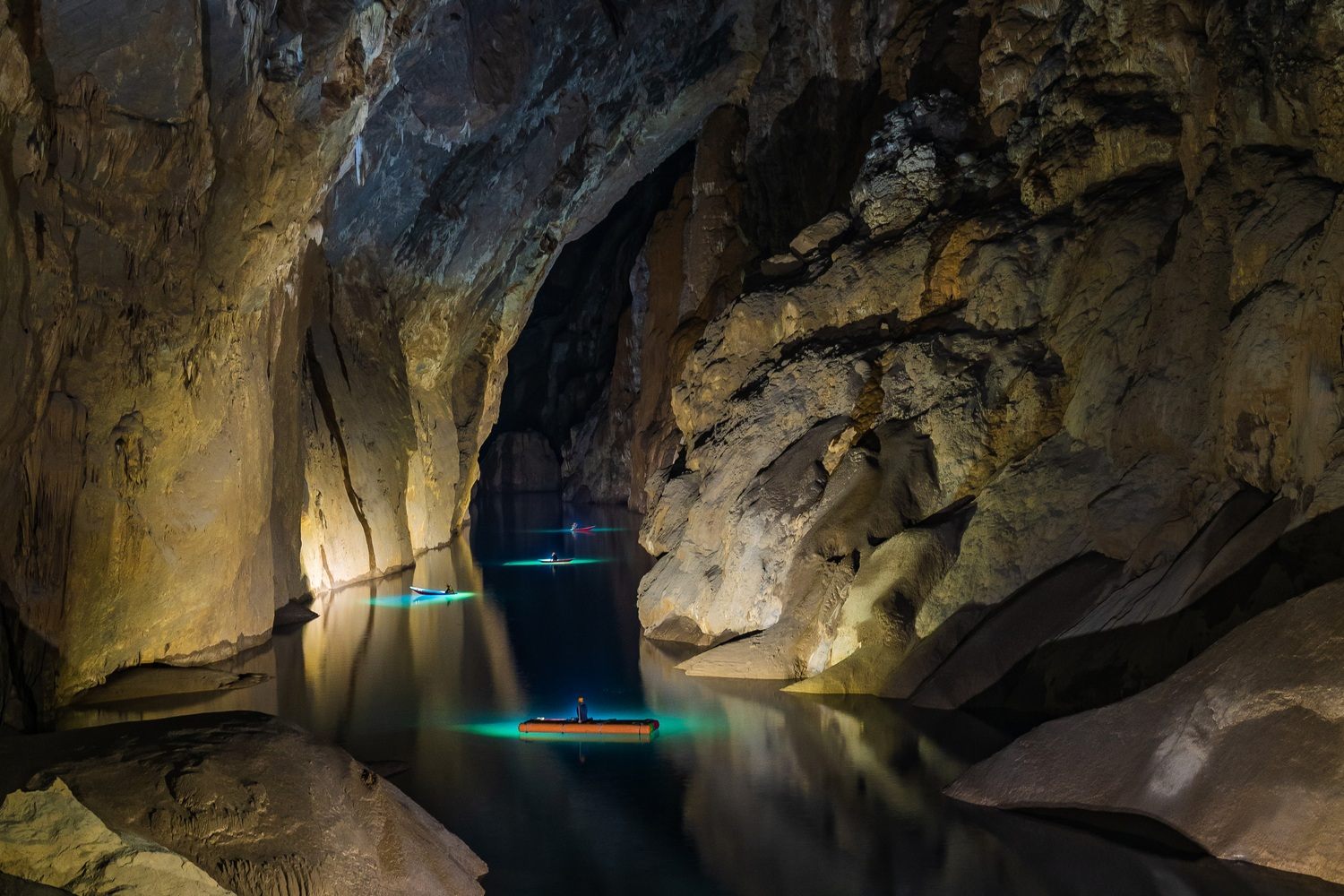
Formed from multiple water sources, the underground river carries a relatively large flow. During the dry season (January–August), the water is crystal clear, with many calm stretches where the surface reflects a stunning emerald hue under the light. In the rainy season (September–November), the water volume surges as streams pour in, causing the river to rise as high as 100 meters. The powerful current sweeps along mud and large tree trunks, leaving them lodged against high cliff walls inside the cave.
The role of the underground river in Son Doong Cave
The underground river in Son Doong has played a crucial role in shaping the world’s largest cave. Over millions of years, its constant and powerful flow eroded the limestone mountains and karst system at depths of more than 100 meters. It carves out a cave stretching over 9 kilometers with massive chambers and magnificent stalagmites. Beyond its geological impact, the underground river also presents a breathtaking landscape and reveals a hidden geological world beneath. Its waters continue to challenge explorers and inspire ongoing research.
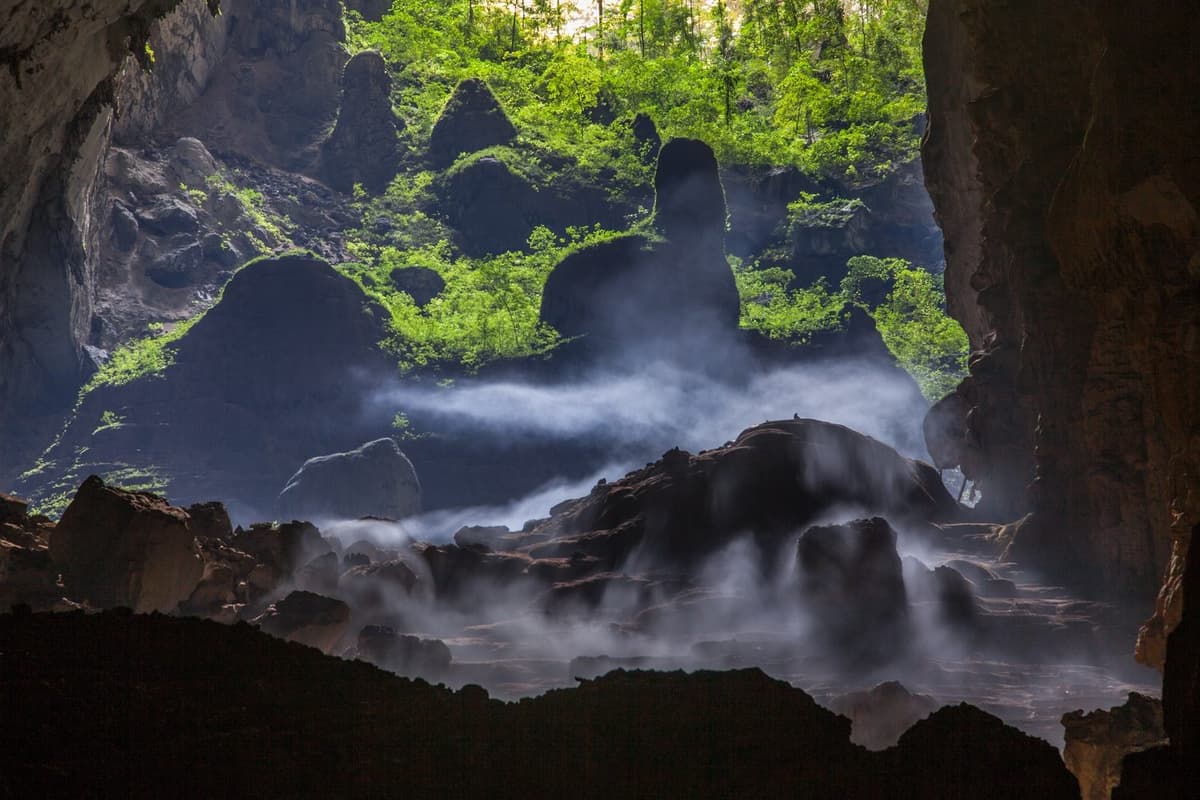
With its long flow and steady temperature of 17–22°C, the underground river helps maintain humidity, regulate the cave’s climate, and sustain life within Son Doong’s ecosystem. The underground streams and massive sinkholes have nurtured rare vegetation and even a pristine jungle inside the cave, while also allowing efficient air circulation. The river is home to the blind fish of Son Doong and supports the survival of spiders, crickets, beetles, flying squirrels, monkeys, and many other species.
The exploration journey of Son Doong’s underground river
From the very first expedition into Son Doong Cave in 2009, explorers discovered that the underground river suddenly vanished into a pool located about 50 meters from Doline 1. Experts strongly suspected that this underground flow could be connected to Thung Cave, roughly 600 meters away.
In 2019, experts returned for the third major survey of Son Doong’s mysteries. This time, accompanied by three of the world’s top cave divers, who had also taken part in the rescue of the youth soccer team in Tham Luang (Chiang Mai, Thailand). Over the course of three dives, it was not until the third attempt that they reached a depth of -77 meters, the deepest cave dive ever recorded in Vietnam. This expedition discovered a hidden passage and an underground chamber leading deeper into the cave. However, with the limitations of current equipment, the team had to pause their exploration and plan for a future dive that could reach depths of -120 meters.
Experiences of exploring Son Doong’s underground river
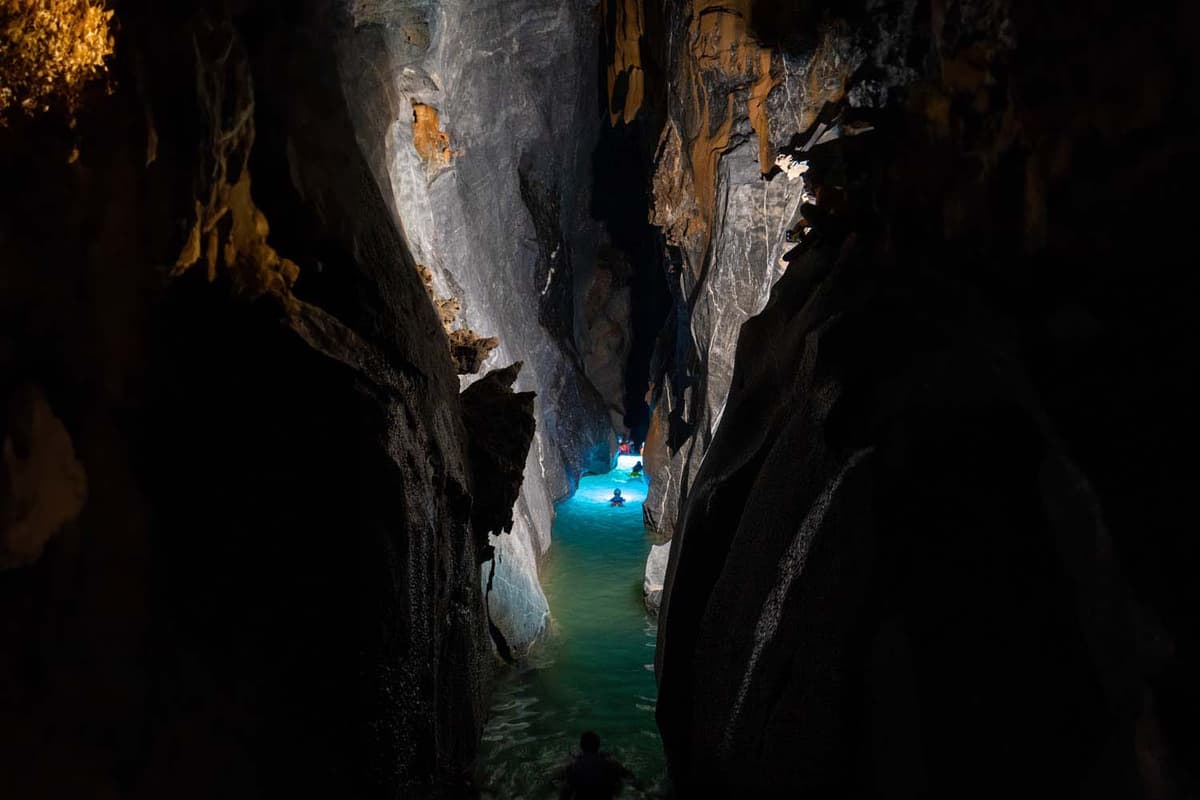
During the Son Doong expedition, travelers have the chance to witness the breathtaking grandeur of the underground river. From the cave entrance, the distant rumble of flowing water stirs excitement within the exploration team. Along the trekking route through the cave, travelers wade across shallow streams, feeling the refreshing breath of this natural wonder deep inside Hang Son Doong.
The deeper travelers venture into the cave, the rougher the trekking terrain becomes. They must climb a rocky slope halfway up the cliff, following the murmur of the underground river below. From this vantage point, travelers can marvel at the grandeur of the river system, observing its vast scale and intricate flow patterns from above.
On the second day of the expedition, travelers get the chance to swim in the underground river like true explorers, passing through a narrow corridor flanked by towering rock walls. Later, as the journey continues toward the end of the cave, the team crosses the Passchendaele Passage by boat to beneath the Great Wall of Vietnam. From there, travelers face the final challenge: climbing the colossal 90-meter-high flowstone wall to reach the exit of Son Doong Cave.
Some notes for exploring the underground river in Son Doong Cave
Travelers who wish to join the Son Doong Expedition Tour and experience the underground river should keep the following in mind:
– Tour booking: To reach the underground river inside Son Doong, travelers must join the official Son Doong Expedition Tour and secure a booking in advance through the Oxalis Adventure website.
– Best time to visit: The ideal season to explore Son Doong Cave is from January to August, when the weather is dry with little rain, making outdoor trekking activities more favorable.
– When trekking: Travelers must follow the instructions of the guide during the expedition and exploration of the underground river.
– When swimming in the underground river: Travelers must wear a life jacket and avoid using soap or chemical-based shower gels while bathing.
– Physical preparation: Regular exercise is essential. Travelers should be able to run 5 km within 50 minutes and climb 5 flights of stairs continuously without dizziness or shortness of breath.
– Trekking experience: Within the past 12 months, participants must have completed at least one overnight trekking tour and one to two full-day trekking tours.
Efforts to preserve the ecosystem of Son Doong Cave and its underground river
The underground river of Son Doong Cave, along with its geological formations and cave ecosystem, is a magnificent creation of nature that has taken millions of years to form. For this reason, the preservation of its natural environment and ecosystem is always the highest priority.
Oxalis Adventure is the only licensed operator of tours in Son Doong Cave and Vietnam’s leading adventure travel company. The company has implemented several environmental protection measures, including:
- Limiting traveler numbers to just 1,000 travelers per year and a maximum of 10 travelers per tour.
- Using water filtration systems at campsites and providing reusable water bottles for travelers.
- Designing and applying eco-friendly Composting Toilets.
- Sorting and carrying all waste, leftover food, and trash out of the jungle for proper composting and disposal.
Every year, at the end of the tour season, Oxalis dismantles all campsites, removes equipment from inside the cave, and restores the environment to its natural state.
Along with efforts to preserve nature while enhancing the traveler experience, Oxalis also encourages travelers to take part in protecting the ecosystem and the underground river of Son Doong Cave by following these guidelines:
- Do not litter in the jungle or inside the cave (trash bins are available at campsites).
- Stay within the marked paths inside the cave.
- Do not touch stalagmites or stalactites.
Avoid using chemical-based soaps or shampoos when bathing or swimming in the cave.
Before the immense power of nature, where limestone, water, and underground currents have carved out this majestic cave wonder, people can truly feel their own smallness. The mysterious beauty of Son Doong’s underground river continues to inspire explorers and travelers to come, witness it firsthand, and take on the challenge.
Travelers who wish to join the Son Doong Expedition Tour should book early, as this world-renowned tour is highly sought after and the 2028 slots may sell out quickly.
For detailed information about the itinerary, tour prices, and how to get to Son Doong Cave, travelers can visit the Oxalis website or contact the Oxalis Adventure team for consultation.