




Since its discovery and survey in 2009, Son Doong Cave has garnered worldwide attention through international media and magazines due to its massive size, fascinating geology, and unique natural phenomena. Stretching nearly 9 kilometers underground with sections that plunge tens of meters deep, the cave also has its own distinct weather. Inside, clouds can form, and sunlight streaming through the sinkholes creates breathtaking sunbeams that captivate both adventurous travelers and international filmmakers.
This article will introduce the unique weather inside Son Doong Cave and explain the reasons behind these special conditions, helping travelers gain insights and better prepare for their adventure.
Location of Son Doong Cave and the Regional Climate
Son Doong Cave is located in the core zone of Phong Nha – Ke Bang National Park, in Phong Nha commune, Quang Tri province (formerly part of Quang Binh province before the administrative merger). The climate in Phong Nha – Ke Bang is directly influenced by Central Vietnam’s weather patterns and the Lao winds, making the summer months (June to August) quite hot, while the winter months (December to February) are relatively cold.
However, the route to Son Doong Cave lies deep within the core zone of Phong Nha – Ke Bang National Park, surrounded by mountains and dense vegetation that help regulate the climate, creating four distinct seasons. The Son Doong Expedition Tour operates from January to August each year, with weather conditions varying by season as follows:
- From December to February, it is the cold winter season, characterized by chilly air fronts and limited sunshine; however, the trekking paths remain pleasantly cool.
- From March to May, spring brings warmer weather and many sunny days. This is also when the forest flourishes, with lush green canopies and wildflowers blooming.
- From June to August, summer arrives with plenty of sunshine, and on the hottest days temperatures can reach 37–38°C. However, most of the trekking route is shaded by forest cover, keeping it relatively cool.
- From September to November, autumn coincides with the rainy season. The Son Doong Expedition Tour does not operate during this time to allow the ecosystem to recover and to ensure safety for all journeys.

Unique weather of Son Doong Cave and its fascinating phenomena
The distinct climate inside Son Doong Cave not only helps maintain a stable temperature but also creates remarkable weather phenomena within the cave itself. During summer, while outdoor temperatures can be quite high, the cave remains at a steady 22–25°C, offering a cool and comfortable atmosphere. In winter, even when monsoon winds and cold fronts are at their strongest, the temperature inside the cave still stays between 17–22°C.
At the cave entrance, travelers can feel cool air carrying moisture flowing out, often forming clouds. As they rappel 80 meters down into the cave, they gradually adjust to the refreshing, cool temperature inside.
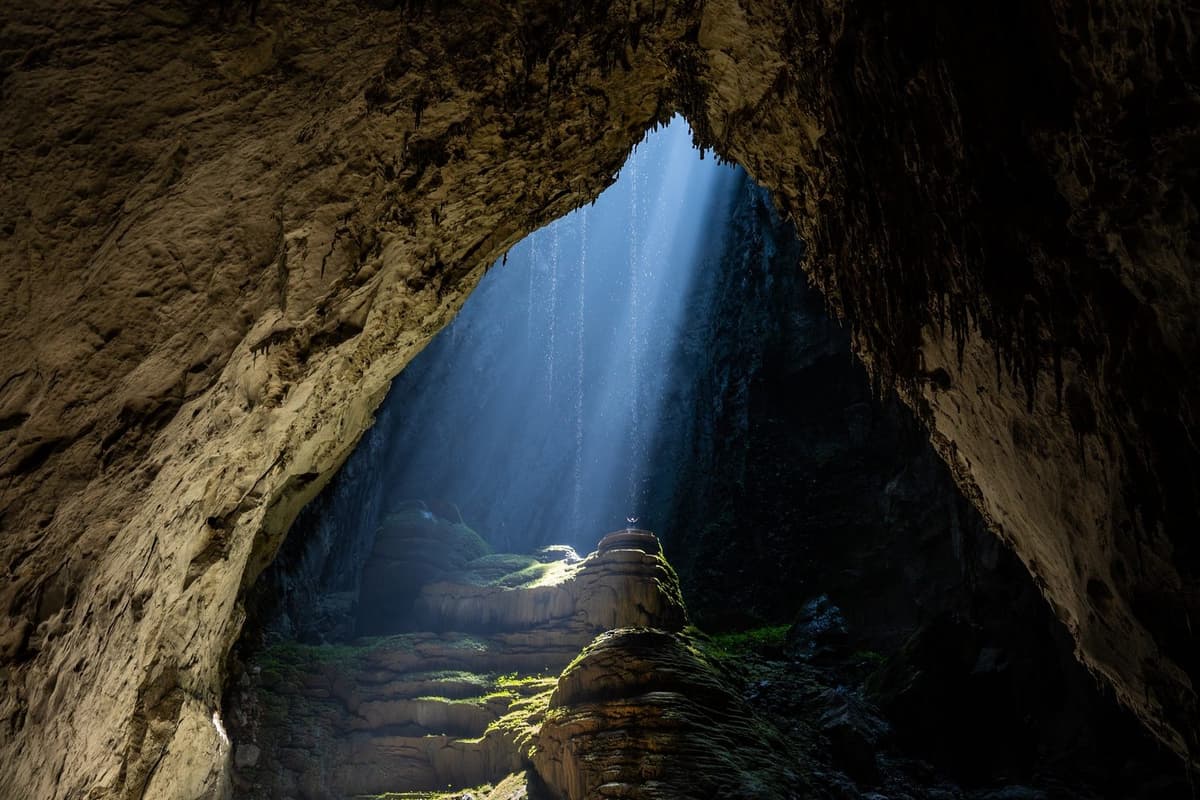
From January to March, at the first doline, also known as Dinosaur Watch, sunlight streams into the cave, creating stunning sunbeams that illuminate the vast underground chamber with a radiant glow.
From June to August, travelers standing at the cave entrance or at the campsites near the dolines in Son Doong can witness clouds forming and drifting gently inside the cave. Especially at the second doline, they will be greeted with the magical sight of a primeval forest hidden among floating clouds, creating an otherworldly and unforgettable scene. The unique weather conditions inside Son Doong have also created an ideal habitat for many rare species of plants and animals, with the most remarkable feature being the vast, primeval forest that rises tall within the cave. It takes about 30 minutes to trek across this jungle before continuing deeper into the expedition.
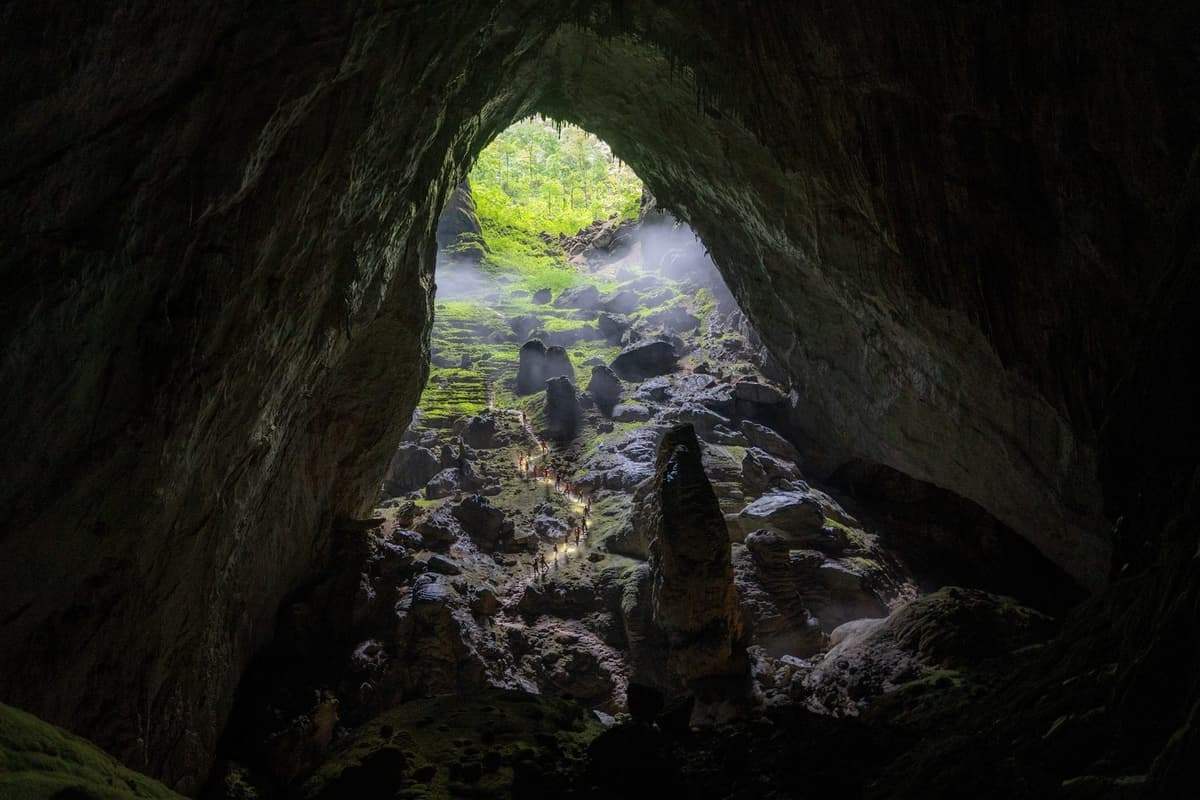
From September to December, the rainy season increases the flow of the underground river inside Son Doong, making the current much stronger. This river originates from small streams in the Truong Son forests. During this time, water levels inside the cave can rise as high as 80 meters, carrying tree trunks upward. When the water recedes, traces such as tree debris and layers of mud remain clinging to the high rock walls.
The cause behind Son Doong’s astonishing weather phenomena
The unique climate inside Son Doong Cave and its extraordinary weather phenomena are the result of the cave’s massive structure combined with its underground river system.
Based on its structure, Son Doong is a through cave with two entrances and two large dolines that allow excellent airflow. However, because the cave reaches a depth of over 80 meters and stretches nearly 9 kilometers with complex geological formations, two enormous dolines have formed in its middle section. These openings let sunlight penetrate the cave (most notably the sunbeams at the first doline), while also enabling air circulation and climate regulation inside Son Doong. As travelers pass through these dolines, they can feel slight temperature changes thanks to the airflow and exposure to natural light.
In addition, the underground river inside Son Doong Cave carries a large volume of water from multiple sources, creating a continuous flow that helps regulate the temperature and maintain humidity deep within the cave. Thanks to this, the temperature inside Son Doong remains stable at around 20–25°C, keeping the air cool in summer and warmer in winter. Especially during the summer months, moisture rising from the underground river and aquifers condenses into mist suspended in the cave. When sunlight filters through the dolines and meets this mist, it creates a mesmerizing light refraction effect, illuminating the cave and allowing travelers to clearly see the drifting clouds within.

Weather shifts create remarkable journeys
The changing weather inside Son Doong Cave brings unique experiences throughout the expedition. From the very entrance, travelers encounter an ever-shifting cycle of light and darkness as they journey through two massive dolines, before finally conquering the 90-meter-high Great Wall of Vietnam to reach the exit. Within the vast darkness, the cave’s complex formations and colossal stalagmites, illuminated by headlamps, appear radiant, majestic, and full of mystery.
In spring, the dolines are filled with fresh air and sunlight, creating a bright landscape of forests, limestone cliffs, and gleaming stalagmites. Travelers exploring Son Doong during this season may witness the extremely rare sunbeam phenomenon. Brilliant rays of sunlight stream through, illuminating the colossal stalagmites and gradually spreading across a vast stone slope covered in moss and ferns. The giant rock beside the lake at the foot of the slope, along with the peak of the Wedding Cake stalagmite, becomes a spectacular photo spot where travelers can capture stunning shots under the radiant sunbeams.
When exploring Son Doong Cave in summer, travelers may see the campsites near the dolines surrounded by floating clouds. At both dolines where sunlight enters, thick clouds often gather, covering the towering rock slopes and the primeval forest in a mystical mist that fascinates and delights many travelers.
On rainy days, the dolines can even transform into natural waterfalls, with rainwater streaming down more than a hundred meters from their rims like cascading curtains.
Travel tips for exploring Son Doong Cave
To conquer the world’s largest cave, travelers need strong mental and physical preparation, including the ability to run 5km in 50 minutes and climb 5 flights of stairs continuously. Since the Son Doong Expedition Tour lasts 6 days and 5 nights, covering a total distance of about 25km across diverse terrains, travelers are required to have prior trekking experience of at least one overnight trek and 2–3 day treks within the past 12 months.
Here are some useful tips and safety notes for travelers joining the Son Doong Expedition Tour:
- The best time to explore Son Doong Cave is from January to August.
- To join the Son Doong Expedition Tour, travelers must book in advance through the Oxalis Adventure website.
- Bookings cannot be resold or transferred.
- Prepare comfortable, breathable, and quick-dry trekking clothes. Choose trekking shoes with good drainage and a strong grip.
- During trekking and cave exploration, always follow the guide’s instructions and never separate from the group.
- Do not use chemical-based soaps or shampoos when bathing in the forest or inside the cave.
The weather inside Son Doong Cave is a striking testament to the power and wonder of nature. This force created the world’s largest cave and countless surprises to challenge the hearts of adventurers. As the Son Doong Expedition is highly popular among both international and Vietnamese travelers, tours for 2026 and 2027 are already fully booked. Those wishing to join can now reserve their spot for 2028.
Travelers who wish to learn more about the itinerary, tour prices for the Son Doong Expedition, or related details, such as travel guidance to Son Doong Cave, can contact the Oxalis Adventure consulting team for assistance.